Introduction
High-angle photobooths create a very specific kind of couple photo: clean, flattering, and instantly “scroll-stopping.” Because the camera is positioned overhead, traditional couple poses (the ones designed for eye-level cameras) don’t always translate well. Hands can block faces, spacing can look awkward, and the shot can feel flat unless you intentionally build shapes and movement into the frame.
This guide breaks down high-angle photobooth poses for couples that work specifically for top-down photography. You’ll learn how to position your bodies, where to place your hands, and what small micro-movements to do between shots so every photo looks natural—not stiff or overly posed. Whether you want sweet, playful, or editorial-style images, these pose ideas are designed to help you get consistent results in a self-shoot studio or high-angle photobooth without needing a photographer.
Key Takeaways
- High-angle couples photos need different posing rules. Overhead cameras reward symmetry, clean spacing, and intentional hand placement more than eye-level shots.
- Protect the “face zone.” Keep hands slightly above or below the face—not directly over eyes, brows, or mouths—to avoid blocking expressions.
- Use shapes to make photos look premium. Hearts, frames, halos, wings, and curved arm lines add structure and visual interest from a top-down perspective.
- Distance matters more than you think. Aim for 20–35 cm between faces (or heads) so both faces stay visible and the shot doesn’t feel crowded.
- Micro-movements create variety fast. Switch eye lines (camera vs partner), change head tilt, and cycle expressions (soft smile → laugh) to get multiple usable photos per pose.
- Symmetry reads as “clean” and “high-end.” Centre hugs, cheek-to-cheek, and head-to-head floor poses work exceptionally well in overhead framing.
- Shoot in quick bursts. Take 3–5 shots per pose to capture the best “in-between” moment (the one that looks candid but still polished).
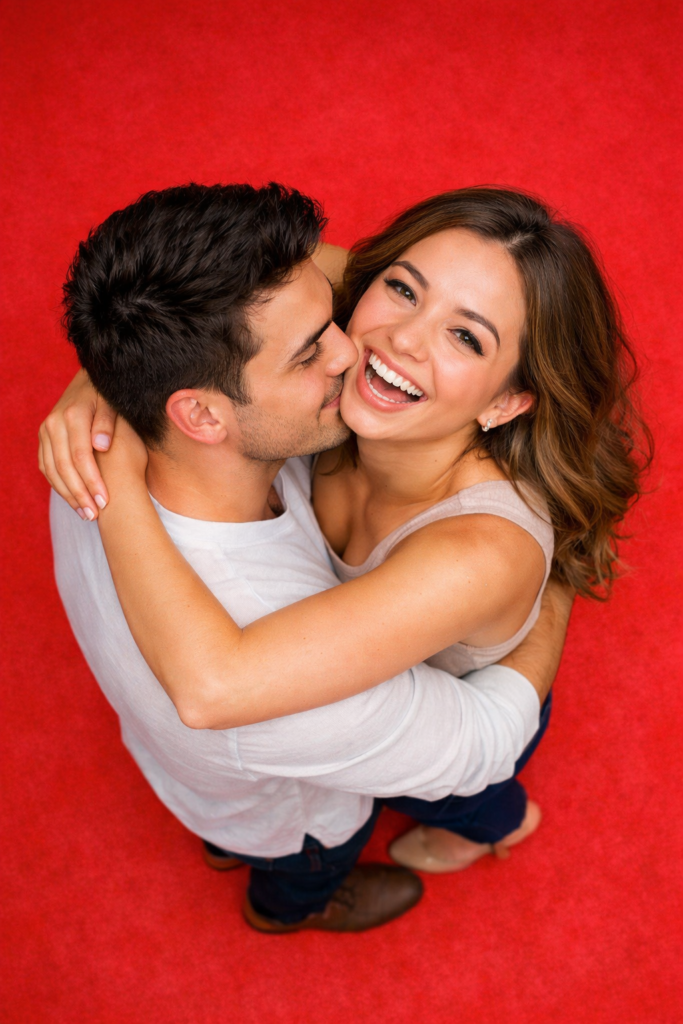
1) “Centre Hug + Look Up”
Goal: clean, romantic, symmetrical.
Body placement:
- Stand close, toes slightly outward.
- Partner A wraps arms around Partner B’s waist; Partner B’s arms rest over A’s shoulders (light clasp behind neck).
Head & face: - Foreheads almost touching; both look up to lens.
- Soft smile first, then one laugh frame.
Hands detail: - If B’s arms are over shoulders, hands should rest gently on the upper back/neckline (no clenched fists).
Best framing check: keep both faces fully inside the “head zone” (no cropped foreheads).
Variations: - A looks at B (side-eye), B looks at camera.
- Eyes closed + forehead touch (1–2 frames only).
- Add a tiny spin-in-place before the hug to loosen posture.
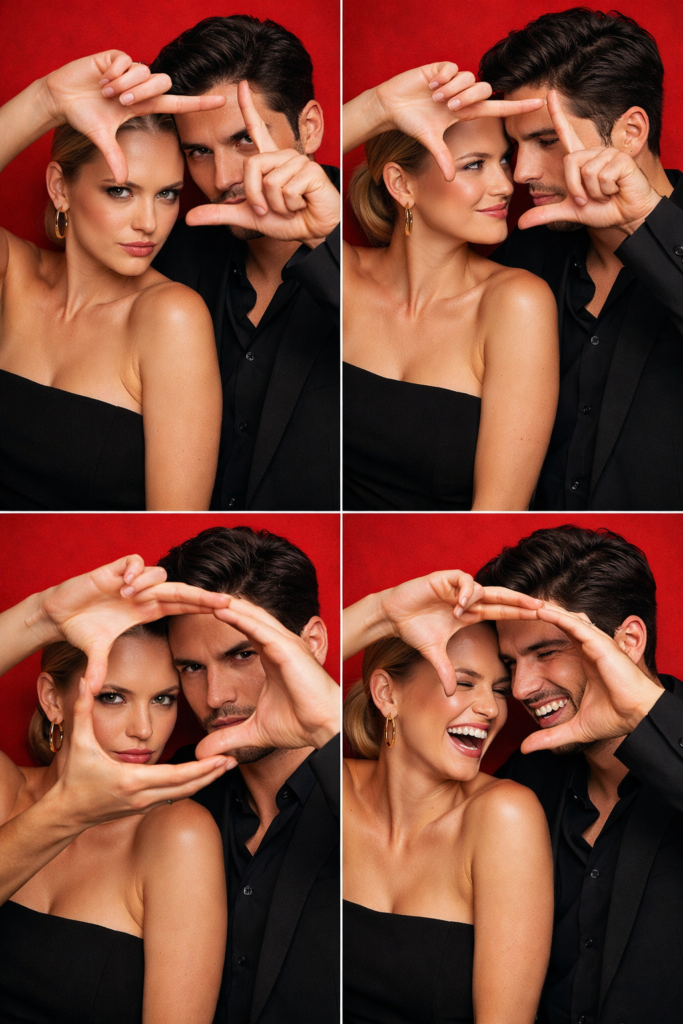
2) “Cheek-to-Cheek + Hand Frame”
Body placement:
- Stand shoulder-to-shoulder, bodies aligned.
- Cheeks lightly touching (no squish).
Hand choreography (key): - Free hands form a rectangle “frame” around your faces (like you’re framing a photo):
- Each partner uses both hands or one hand each to create the corners.
- Fingers extended, relaxed, not stiff.
Eye line:
- Both look at lens for 2 frames; then one looks at the other.
Variations: - Change the frame shape: triangle, circle, “C” shape.
- Add “serious face” then switch to laugh (great sequence).
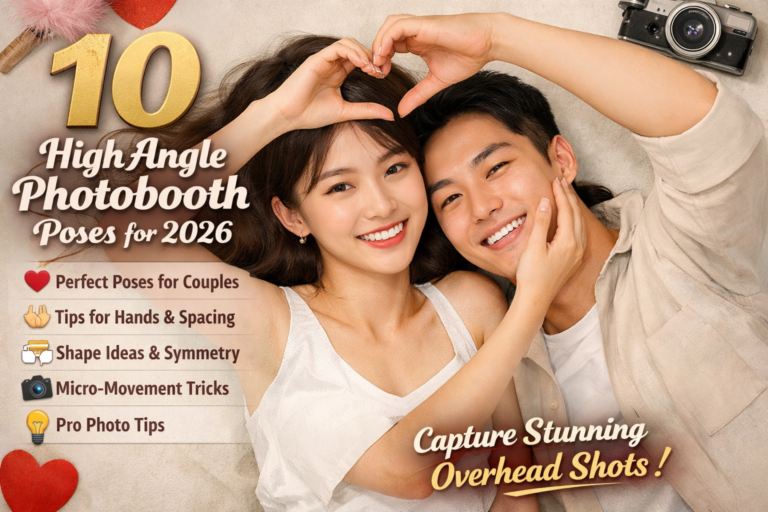
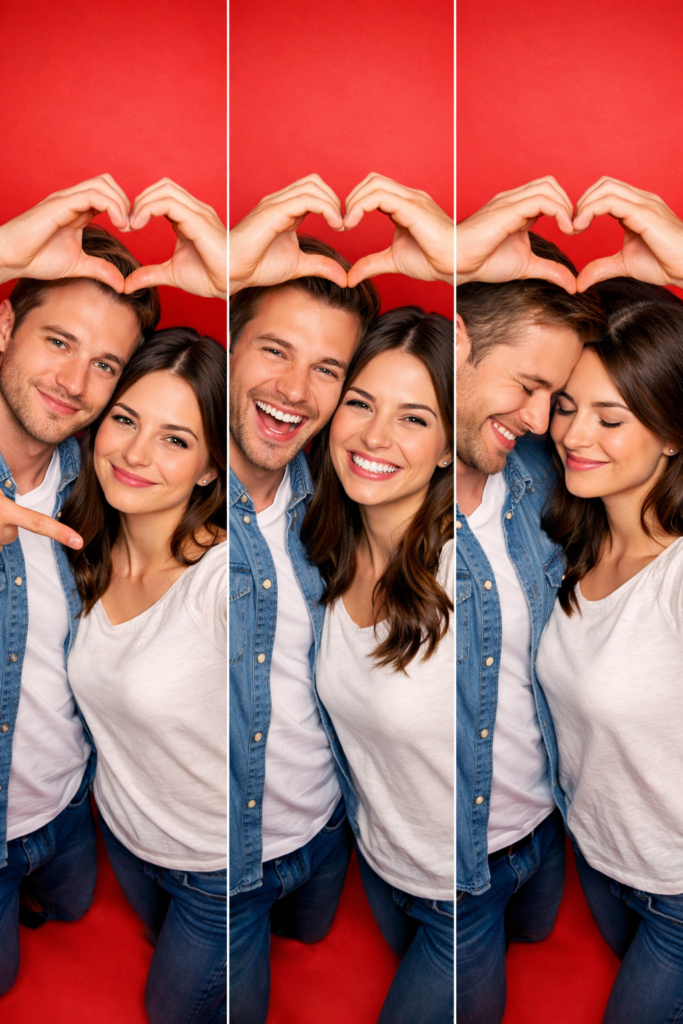
3) “Overhead Heart Hands”
Body placement:
- Stand close but keep faces visible; don’t let hands block eyes.
How to form the heart (best overhead): - Make the heart slightly above forehead level so faces remain clear.
- Thumbs touch at the bottom point; index fingers create the curve.
- Keep wrists soft, elbows slightly outward for a smooth shape.
Expression timing: - Frame 1: calm smile.
- Frame 2: big smile.
- Frame 3: close eyes while smiling (sweet).
Variations: - One heart together + one partner points at the other.
- Heart hands + forehead touch (hands higher to avoid blocking).
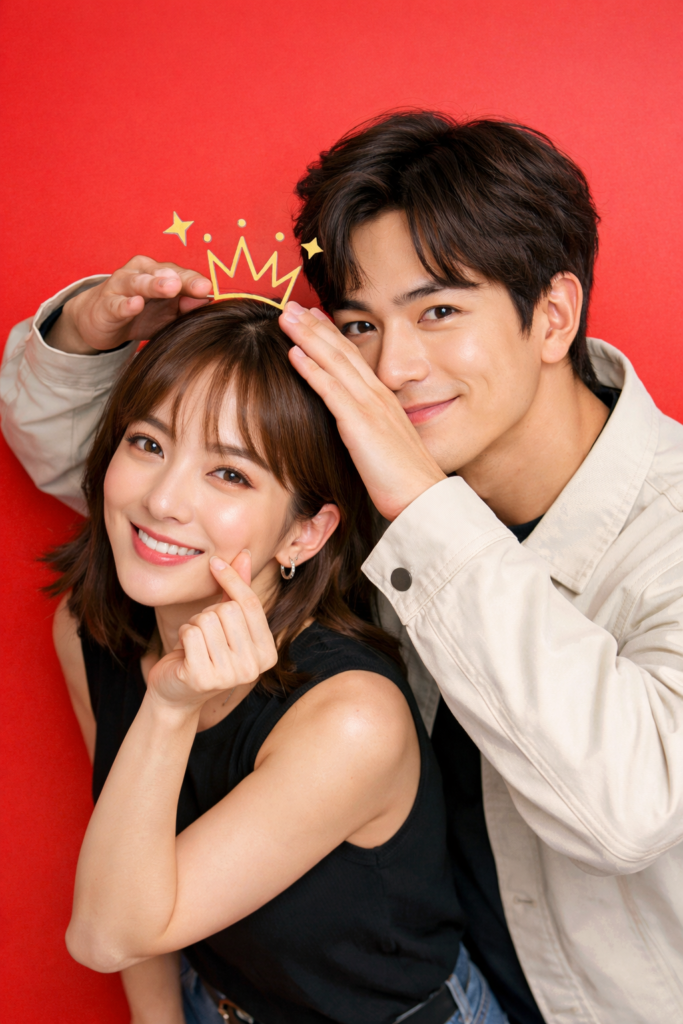
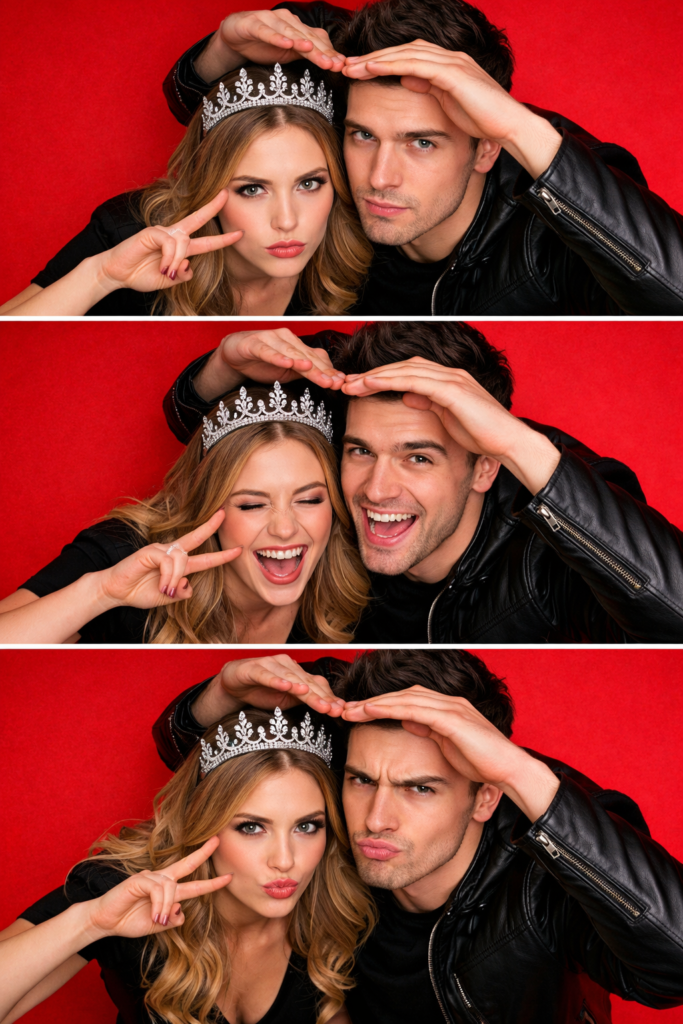
4) Diagonal “Crown” Above Head
Body placement:
- Stand close, angled same direction.
- Partner A slightly in front.
Hands: - Partner B makes a “crown” above A’s head (hands hovering above hairline, not blocking face).
- Partner A forms a small heart/peace sign near cheek (kept low so it doesn’t cover eyes).
Eye line: both look at camera.
Variation: swap who wears the crown.
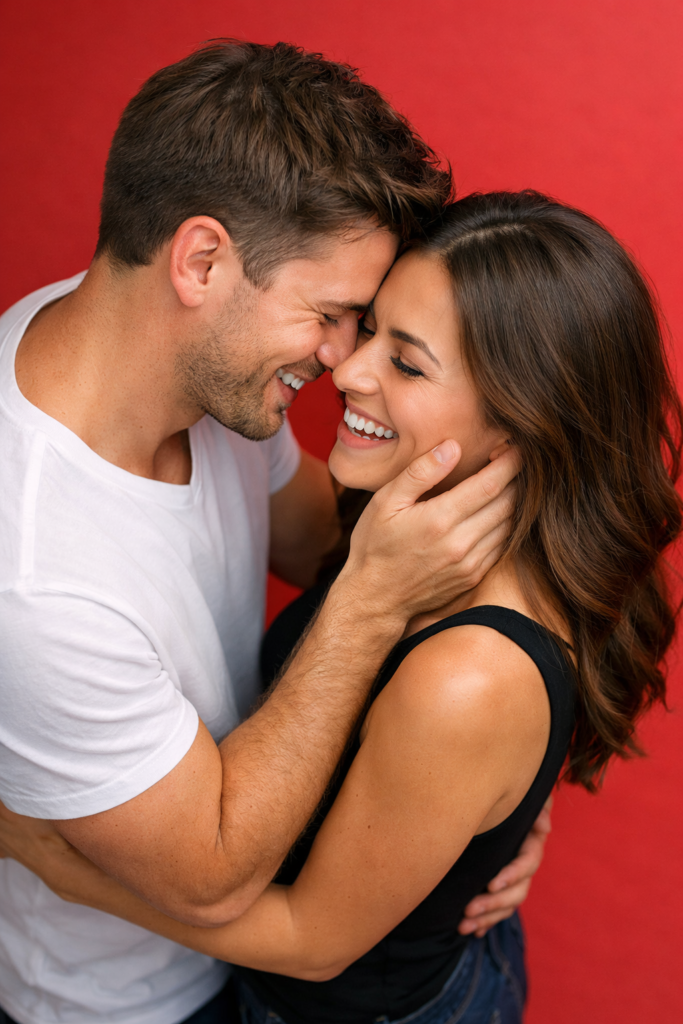
5) “Nose Touch + Mini Kiss (No Contact)”
Body placement:
- Stand close, face-to-face, noses nearly touching.
Hands: - Partner A holds Partner B’s jawline lightly (fingers along cheek, thumb near cheekbone).
- Partner B holds A’s waist.
Action: - Pause at “almost kiss” for 1 second.
- Pull back and smile immediately (best reaction frame).
Variations: - Whisper something short, then laugh.
- Forehead touch instead of nose touch (softer).
6) “The ‘Crown’ Pose”
Body placement:
- Stand cheek-to-cheek or close side-by-side.
Hands choreography: - Partner A forms a crown over Partner B’s head using both hands.
- Partner B points at Partner A or does a peace sign near cheek.
Expression timing: - Frame 1: serious “royal” face.
- Frame 2: laugh.
- Frame 3: both do exaggerated “model face.”
Variations: - Switch who wears the crown.
- Add a prop crown or headband if available.
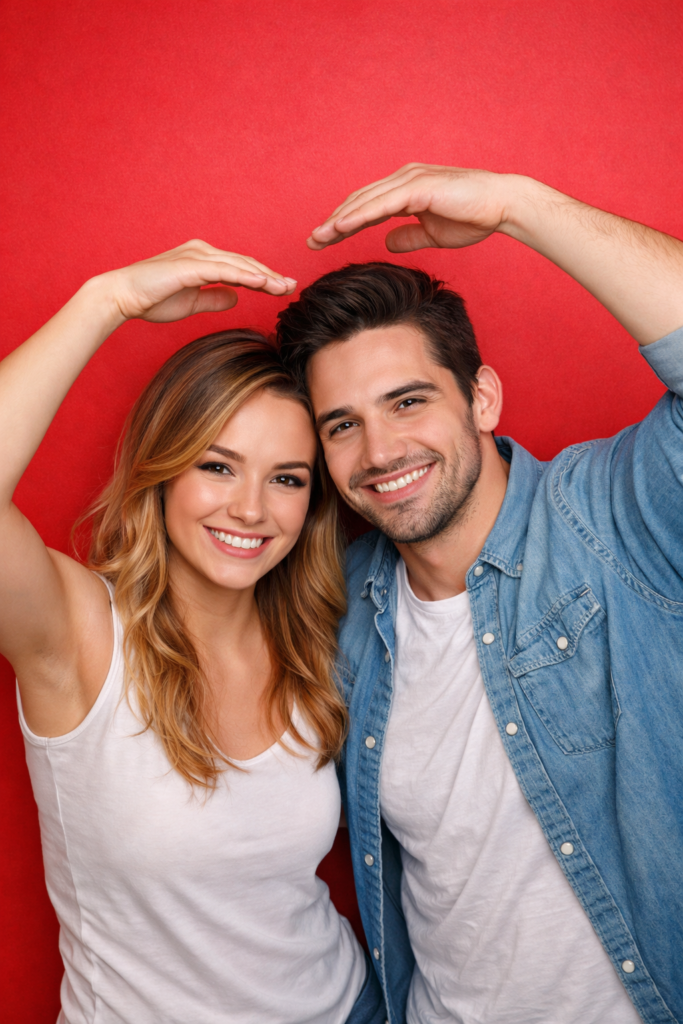
7) Diagonal “Halo Arms”
Body placement:
- Side-by-side, angled same direction, shoulders touching.
Hands: - Both raise arms in a gentle curve above head (like a halo/arch).
- Keep hands open; fingers separated slightly for clean lines.
Important: the arch should sit above the forehead—not across the face.
Eye line: both look at camera.
Variation: one partner does halo, other does heart.
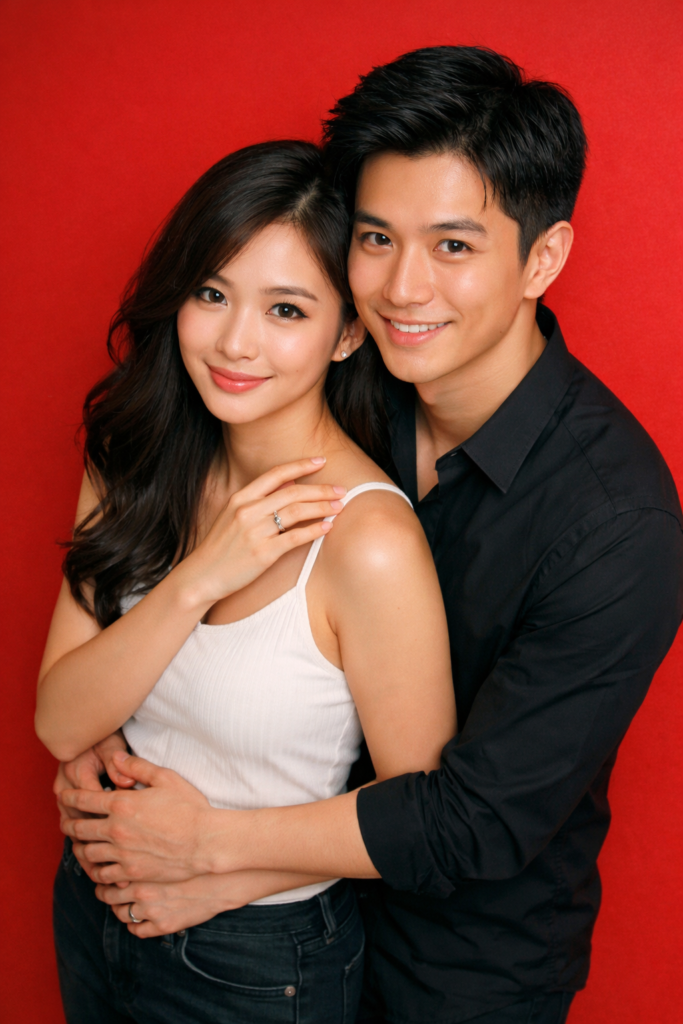
8) Diagonal Waist Hold + Shoulder Lean
Body placement:
- Stand angled same direction, Partner B half-step behind.
- Partner A leans shoulder/back lightly into B.
Hands: - B holds A at waist (both hands if you want “secure” vibe).
- A places one hand over B’s hands; other hand touches collarbone or hair.
Eye line: both look at camera.
Micro-variation: A closes eyes for 1 frame (optional), then opens for the “hero” frame.
9) Diagonal “Double Cheek Hold”
Body placement:
- Stand close, angled same direction, faces near.
Hands: - Each partner uses one hand to gently hold the other’s cheek (light touch, fingers spread).
- Keep thumbs away from lips; don’t cover the mouth.
Eye line: both look at camera.
Expression sequence: pout → smile → laugh (three frames).

10) Diagonal “Power Couple” Stance
Body placement:
- Both stand angled same direction, with a slight gap between hips (5–10 cm).
- Partner A slightly in front; Partner B slightly behind.
Hands: - Both place one hand on hip (outside hand).
- Inside hands either linked low at waist or relaxed by side.
Eye line: both look at camera; confident expression.
Variation: one partner smiles, the other stays neutral.